There is No Word as “Compromise” in Kobe Beef
Kobe beef is Wagyu beef, but not all Wagyu beef is Kobe. Only the top quality carcass from the best pedigree Tajima gyu cattle makes Kobe. For being Kobe beef, a carcass of Tajima gyu cattle has to meet stringent criteria set by Kobe Beef Marketing and Distribution Promotion Association.
Grading of Wagyu beef
Wagyu is a Japanese term meaning “Japanese Cattle”. Each and every Wagyu carcass is scored according to the standards set by the Japan Meat Grading Association that is the only meat grading institution authorized by Japanese government.
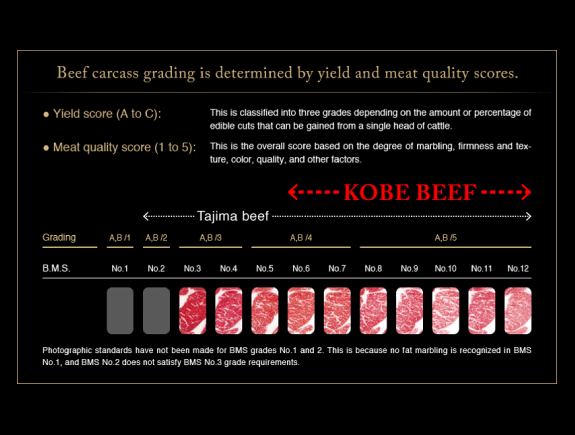
Grading is assessed by both Meat Quality Score and Yield Score. Meat Quality is scored by five factors of “marbling”, “meat color”, “fat color”, “brightness” and “texture”. Each factor is graded from 1 to 5, with 5 being the highest score. Yield refers to the ratio of meat to the total weight of carcass and it is graded A, B or C, with A being the highest score. In Japanese grading system, carcass falls in one of 15 different grade categories with A5 being the highest and C1 the lowest.

Criteria for Kobe Beef
Kobe Beef is the most premium beef brand granted to the top quality carcass of pure-lineage Tajima gyu cattle. Neither hybrid Tajima gyu nor other Wagyu strains make Kobe beef. For being Kobe beef, cattle is to be born, raised, slaughtered and processed in Hyogo Prefecture specifically and is at the age between 28 and 60 months of bullock or uncalved cow. In addition, carcass needs to score Meat Quality score of A or B, Yield Score of 4 or 5 and Beef Marbling Score (BMS) of 6 or higher. Furthermore, gross carcass weight must be 470 KG or less.
Due to the stringent criteria and quality control management by Kobe Beef Marketing and Distribution Promotion Agency, only 3,000 to 5,000 carcasses of Tajima gyu cattle are qualified for Kobe beef annually. Most of which is consumed in the local market where there is a high demand for it and very few are exported overseas.
Traceability
In 2003, “Beef Traceability Act” came into effect. It provides a legal framework for Japan’s beef traceability system. Under the system, each Tajima gyu cattle is provided 10‐digit ID number and it can trace movements at any point in the supply chain from genetic lineage, birth record, age, gender, harvest record, ownership of the animal and farmer to slaughterhouse, wholesaler and retailers. This traceability system is a cornerstone of Japan’s beef safety policy.
Geographic Indication
Geographic Indication (GI) is a name or sign used on products that have a specific geographical origin and process qualities or a reputation that is due to that origin. Kobe beef has been registered as a regional brand product under the Geographical Indication protection system of the Ministry of Agriculture, Forestry and Fisheries.

Kobe Beef Trade Mark
Trade mark of Kobe beef is stamped on carcasses that satisfy all the requirements set by Kobe Beef Marketing and Distribution Promotion Association. It is designed from Chrysanthemum, a floral emblem for Hyogo Prefecture.
Tajima Bronze Statue
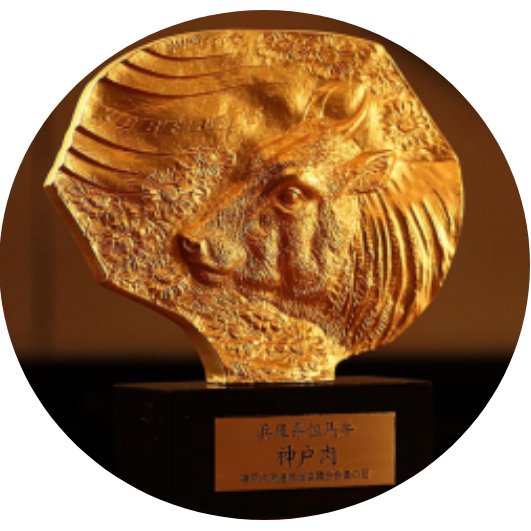
Kobe Beef Marketing and Distribution Promotion Association promotes and upholds the stringent standards for Kobe beef. Wholesalers, importers/exporters, retailers and restaurants must be authorized by the Association before marketing Kobe Beef. Bronze statue of Tajima gyu placed at their shop front is the symbol of the authorized Kobe agent.