Tajima Gyu Cattle and Home Land

The Champion of Champions

There is Nothing More Important than Pedigree

Tajima gyu cattle is regarded as the best quality beef cattle of all the Japanese beef breeds. Above all, only purebred Tajima gyu cattle makes Kobe beef.

Pure lineage and superb genes

Wagyu is a breed of cattle native and unique in their genetics to Japan. They are genetically predisposed to intense fat marbling and to producing high levels of monounsaturated fat. Today there are four registered Wagyu breeds of Japanese Black, Japanese Brown, Japanese Shorthorn and Japanese Poll. Japanese Black takes up 90% of fattening cattle production and Tajima gyu cattle belongs to Japanese Black.

As part of modernization movement under Meiji Restoration, Japanese government imported continental cattle breeds for crossbreeding purpose after 1868. This attempt, however, turned out to be a total failure as crossbreds did not improve the most important economic traits for farmers – working performance. Although crossbreeding with foreign breeds was abandoned by the early 20th century, a gene pool of native Japanese cattle population had been extensively affected. Tajima gyu cattle was no exception to this.

Today’s Tajima gyu cattle is from a group of pure Tajima gyu cattle that had been insolated in Atsuta, a village community in deep mountains, and avoided crossbreeding with foreign breeds. Kobe beef is made from pureblooded Tajima gyu cattle only whose stringent quality control is explained in the subsection “Criteria for Kobe Beef”.

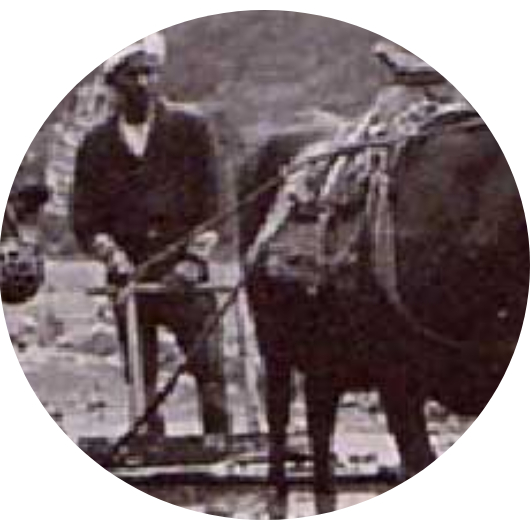
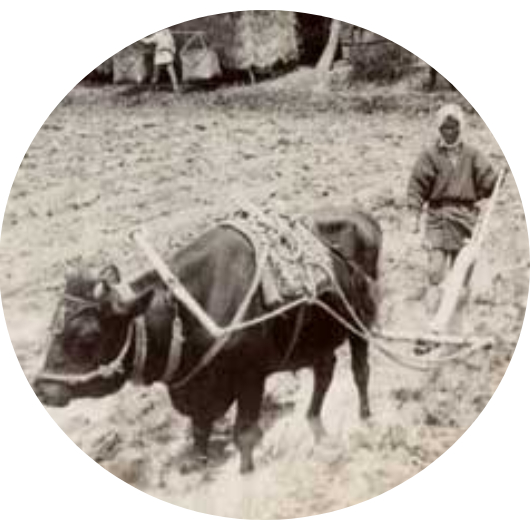
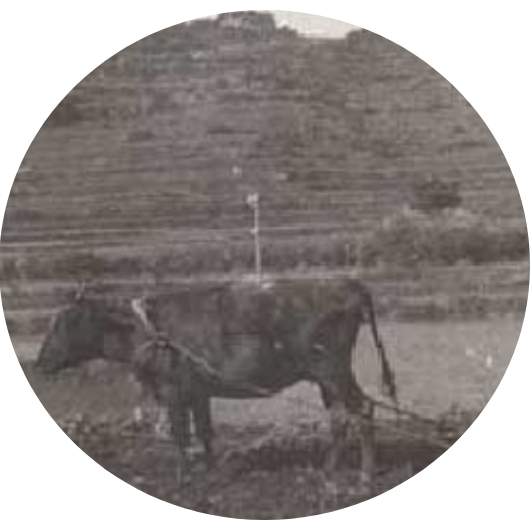
Tajima gyu cattle as draft animal

Cattle was used as draft animal and was an integral part of farmers’ life until the mechanization of farming took over in the 1960’s. Tajima gyu cattle plougs in dry field (left and middle) and in rice paddy (right).
Hyogo Prefecture – Native Land of Tajima Gyu Cattle

Beautiful Natural Features of Hyogo Have Shaped Tajima Gyu as What it is Today

Tajima gyu cattle came from mountainous region in Hyogo Prefecture. It is located in midwest Japan with both Sea of Japan in the north and inland sea in the south. Climate of Hyogo Prefecture is relatively mild, with four distinct seasons. In summer, temperature is often in the high 30’s while it goes slightly below freezing point in winter. Spring and autumn are the most comfortable with a mild weather. This region is abundant in fertile soil and fresh water and rice crop has been cultivated over centuries as the most efficient means of food supply. Tajima gyu cattle, as draft animal, had been an integral part of local farmers’ life until 1960’s when the mechanization of farming and chemical fertilizer were prevailed.
Our Faq

Frequently Asked Questions

Kobe beef refers to meat from Tajima-gyu cows certified by the Kobe Beef Distribution & Promotion Council. Tajima-gyu cows, the “motoushi” or purebred seedstock cattle, have maintained a pure bloodline since the Edo period (1615 to 1867) to the present day. Protecting this lineage has also meant protecting its delicious taste, and this contributes to the high cost of producing this delicacy. Although Kobe beef delights the palates of people around the world, it accounts for a mere 0.16% of total beef consumption in Japan. This scarcity is another factor contributing to its high price.

This is due to the many foreigners who first came and settled in Kobe from the Meiji period (1868 to 1912) onwards after Kobe became the first port to be opened to foreign trade on January 1, 1869. From then on, word of its deliciousness soon spread fast.

Kobe Beef started to be exported to Macao for the first time in February, 2012.

I hear that Kobe beef is born from Tajima gyu, which is a “Japanese Black” strain? What, in the first place, are the differences between “Wagyu” cattle and “Kokusan-gyu” cattle?

“Wagyu” or Japanese cattle is divided into four breeds – Japanese Black, Japanese Brown, Japanese Poll, and Japanese Shorthorn. Tajima-gyu cows from which Kobe beef comes from are classified as belonging to the Japanese Black breed.

“Kokusan-gyu” cattle refers to all cows raised domestically in Japan. So, whichever country a cow is from and whatever its breed is, the cow is classified as being “Kokusan-gyu” cattle if it has spent more than half of its life in Japan.

Breeding farms rear mother cows to give birth to calves, while feeding farms raise and care for these calves so that their body mass increases and meat quality improves. Both types of farms require specialist skills and knowledge, and some farms, of course, take on both roles.

On the whole, calves are raised on breeding farms to the age of eight to nine months, after which they are put on show in the calf livestock market. Then, they are raised and fattened in feeding farms for about two years. Once they reach maturity, on average 30 to 32 months from birth, they are slaughtered and sent to the meat market. In particular, it takes an extra two to four months to raise Tajima-gyu cows compared with the regular Japanese Black domestic breed of Wagyu cattle.

As well as dried pasture forage and grasses such as rice straw, they are fed a diet of nutrition-rich feed supplements made by blending together soybean, corn, barley, wheat bran, and various other ingredients. They are given no pasture grass at all to eat. Water, too, is very important besides feed. This is the reason why there are many cattle-rearing farms in areas with good, clean water.

“Sashi” refers to the fatty content of the scarlet-colored muscle fiber. “Sashi” is classified into two types, coarse “sashi” and fine “sashi.” “Shimofuri” refers to the cut of fine texture meat having a high degree of fat marbling.

A feature of Tajima-gyu cows is that they possess both fine muscle fiber and a high degree of fat marbling.

There may well be some farms rearing low numbers of cattle who are doing things bordering on this. But, this does not mean that these rearing methods are all standards for producing prime Kobe Beef. For example, if you make it a custom of playing music at feeding time, then the cows as a conditioned reflex know that it’s feeding time just by hearing the music, and this, it is said, increases their appetite. However, the affect of music improving meat quality has not yet been proved. There is also the theory that beer is useful in improving cows’ appetites. Actually, however, it can be said that there have been almost no cases of cows being raised on beer. And, massage, too, is considered to be useful in lowering cows’ stress because of the close, physical contact it provides and in indirectly helping to improve the quality of the meat. Once again, however, massage itself neither softens meat nor increases the amount of marbling.

All Tajima-gyu cow carcasses are graded and assessed by the Japan Meat Grading Association. The overall meat quality score of carcasses is determined according to four factors – beef marbling, meat color and brightness, firmness and texture of meat, and color, luster and quality of fat – each of which is graded from 1 to 5, with 5 being the highest score.

“Carcass” refers to the state of the cow after its skin, head, organs, and their unusable parts have been removed. Normally, carcasses are bought and sold in auctions. Tajima-gyu cows have a carcass weight of around 400 kg, 50 kg or so lighter than the national average. General opinion amongst farmers is that the fine texture and quality associated with this breed of cow would be lost if it were allowed to grow too large beyond this weight.

Yes, it is. A prerequisite of beef to be officially certified “Kobe beef” is that the bullock or virgin Tajima cow has been born in Hyogo Prefecture from a Tajima cow having a pure lineage, and that the bullock or virgin cow has been bred and raised by a designated farmer in the prefecture and slaughtered at one of the slaughterhouses in the prefecture. It must also pass strict grading for BMS (Beef Marbling Standard), weight limitations and other criteria.

About 7000 head of Tajima-gyu cattle. Only about 5000 of these cattle are certified as Kobe beef.

By the 10-digit individual ID number on display in butchers and restaurants, you can tell a cow’s lineage, where it was born and raised, the market it was sold at, and whether or not it is actual certified Tajima-gyu Kobe beef.